Posted on — Leave a comment

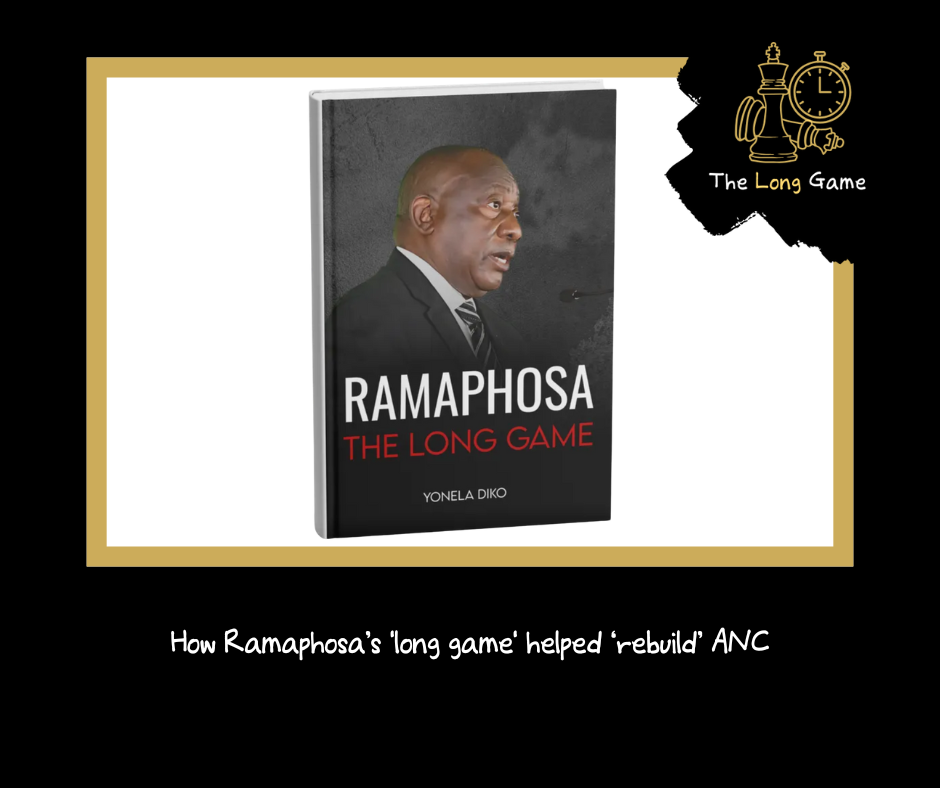
How Ramaphosa’s ‘long game’ helped ‘rebuild’ ANC

Yonela Diko | Published

Long Game Book cover

Image: Yonela Diko

THE task for Cyril Ramaphosa, when he was elected President of the ANC in 2017 and subsequently President of the Republic in 2018 was clear: Revive the economy, eradicate corruption, rebuild state institutions and restore the credibility of the state. The question was how to get there.

This book makes the argument that given these sky-high expectations on the president, an expectation to unite a very divided ANC on one hand- because indeed a very divided ANC would not be able to discharge its party and government responsibilities- and on the other hand to urgently effect consequence

to some of the members of the very ANC, who had betrayed their oaths of office and committed sins against the people, a necessary act that had the potential to divide the very ANC the President was working to unite, Ramaphosa wisely decided to play the long game.

This book makes this point that in order to effect this difficult duality, goals that were effectively at odds with one another, the President chose to focus on rebuilding both ANC and State institutions so that it is the institutions themselves, and not the bully pulpit of the Presidency, that would make the achievement of this difficult duality possible.

The book makes another critical argument that Ramaphosa had picked up valuable lessons over the last 20 years of observing the fate of his predecessors, many of whom were very decisive, but ultimately alienated themselves from their own organisation and left the organisation prematurely and bitter. One of these lessons is that Institutions, and not individuals, must effect political consequences to avoid personality politics. When these institutions are strong and effective, no strong man can escape their reach.

While everyone expected the President to act like a bull in a china shop, and enter every department and fire every corruption accused individual, the President did not think this was a wise approach.

It was better to institute commissions of inquiries, at the NPA, at SARS, PIC and others and recalibrate ANC’s Integrity Commission and National Disciplinary Committee, so that people would face the jury of their peers, and for those in government, the public would be taken along, helping the President insulate himself from being seen as purging those aligned to different factions and further dividing the party.

Certainly, in the end, however long it took, all the President’s detractors, who had seemed too powerful at the beginning of his tenure and threatening to cut his Presidency short, over time, fell under the might of renewed Institutions of the party and state, and all the President could do was to watch as his valiant work of rebuilding institutions paying great dividends.

There were also practical reasons why Ramaphosa was playing the long game and not taking rash decisions to satisfy the daily news cycles. The President was dealt a bad hand by the ANC conference in 2017, a small margin of victory that did not give him an outright mandate to make the sweeping changes he would have liked, paired with leaders who wanted nothing more than to see him fail and a bitter predecessor who was vengeful and wanted to lead from the grave.

Playing the long game however, particularly often choosing consensus over the bully pulpit of the Presidency created a perception that the President did not have the appetite for tough decisions, he takes too long to act, that he is weaker than his fierce opponents, who were willing to stop at nothing to see him serve only one term. It seemed at some point his detractors were more determined than him.

There are leaders however who remember Ramaphosa as a very decisive leader, ruthless even, leaders like Kuben Pillay, who had worked with Ramaphosa at NUM, and leaders like Cheryl Carolus, who was deputy to Ramaphosa when he was ANC Secretary General.

Looking at where some of Ramaphosa’s nemesis at the beginning of his Presidency are today, some in political oblivious and forgotten, others political wanderers looking for a place to call home, and others on their last fray, where they must either swim or drown but they can no longer decide the fate of a President, one sees how playing the long game has been the best strategy for the President.

Playing the long game, however, can have devastating consequences in the short term, and the President was soon to find that out.

This book is about these long-term goals of the President and the short term setbacks he has had to endure. Whether it’s how the President dealt with his former Secretary General Ace Magashule, Busisiwe Mkhwebane, Arthur Fraser and Phala Phala, the Zuma arrest and Phoenix Massacre, Eskom and IPP’s and the world beyond our borders, this book presents a President who sets his sights on the end goals and in the end, I believe the President has finally freed the ANC of its heaviest albatross and its proxies, expressing itself in multiple factions and vulgarisation of ideologies.

The ANC is on its way to rebuilding back better.

This is extract of Diko’s upcoming book, The Long Game. Diko is former ANC Western Cape spokesperson.

Original Article Link: https://iol.co.za/capetimes/opinion/2025-09-07-how-ramaphosas-long-game-helped-rebuild-anc/
Posted on — Leave a comment

YONELA DIKO: Expropriation Act – Redress is good for all South Africans

Yonela Diko

29 January 2025 | 6:34

The fear of being swallowed up by this ‘Black Continent’ from some quarters of the white community has reared its ugly head at every turn, but, after selling fear, the years have shown that these fears have only existed in their heads, writes Yonela Diko.

The former chairperson of the Afrikaner Broederbond, Professor Pieter de Lange, and his team, after meeting the ANC delegation led by Thabo Mbeki in 1986, said: “Look, we Afrikaners thought we needed many things to secure our future… We thought if we didn’t have them, this black continent would swallow us up and the Afrikaners would cease to exist as a people. But the reality is that… we’ve not perished as a people since the Group Areas Act was rendered inoperable. That will open up the way to asking the question: Why do we need a white government anyway?”

In the last 38 years since De Lange made that observation, nothing that has happened has threatened the lives or livelihoods of Afrikaners or white South Africans in general. Every law that has been passed to redress the injustices of the past has not made their lives any worse off.

The fear, however, of being swallowed up by this ‘Black Continent’ from some quarters of the white community has reared its ugly head at every turn, and, after selling fear and a sense of exaggerated grievance by these pockets of white communities, the years have shown that these fears have only existed in their heads.

White South Africans are wealthier than they have ever been.

While the majority of white South Africans do not fear a non-racial society, the few who traffic on fear, white grievance and protection of white privilege have been selling dooms day with every progressive legislation seeking to make our country fairer and more equal, from Employment Equity to Black Economic Empowerment, and more recent acts, BELA and NHI, and now Expropriation Act.

When affirmative action was introduced, Mandela observed in 1997 that “… Whenever we have sought real progress through Affirmative Action, the spokespersons of the advantaged have not hesitated to cry foul, citing all manner of evil – such as racism, violation of the constitution, nepotism, dictatorship, inducing a brain drain and frightening the foreign investor.”

When the Employment Equity Act was finally enacted in 1998, then-leader of the Democratic Party, Tony Leon, opposed the bill, calling it a “pernicious piece of social engineering”. This has been the case with Black Economic Empowerment and other bills aimed at levelling the playing field and opening the economy to all South Africans.

Here we are again, with some representatives of white privilege selling all manner of evil that is supposedly going to come out of the latest bill that has just been passed to correct the injustices of the past.

It’s 2025 and President Cyril Ramaphosa has just signed the Expropriation Act, which seeks to reverse the land dispossession of the colonial 1913 Act, which gave 87% of our land to white minorities, and left only 13% for Black South Africans.

After 30 years of singing the same song while becoming insanely wealthy, white fears are becoming pathological. It is not clear why these fears persist.

While addressing the Goldman Sachs investor conference in May 2019, Ramaphosa said, “…Foreign investors have nothing to fear; there’s no way we can invite foreign investors to our country and say ‘come, invest’ and tomorrow we take your land away. That is not going to happen. That is not sensible. It’s not something that any sensible person does.”

The president also emphasised at the same conference that expropriation would happen. This is important because expropriating land for public purposes is not mutually exclusive with property rights – not here in South Africa or around the world.

Annelize Crosby, the head of legal intelligence at Agbiz, has noted as a matter of fact that “every government in the world can resort to expropriation as a means to acquire property for certain public purposes.”

In fact, expropriation of land for public interest has been the law of the land even before the democratic dispensation and the Employment Act of 1975. The only contentious point now is the ‘nil compensation’ clause. This, however, will mostly be applicable to unproductive land that lays fallow.

Given that a quarter of our people have moved from rural areas to urban centres in the last 25 years in search of work opportunities, we have already seen them invading land spaces that lay fallow because of shortages of land for housing in these urban centres.

Expropriation gives government a legal mechanism to de-congest our people from informal settlements and finally have control of urbanisation, guiding people where they can settle, building dignified structures for our communities with roads, water electricity and other basic services. No community can claim to have been unjustly targeted to suffer from government policies.

This may explain why the Stellenbosch academic, Willie Esterhuyse, exclaimed all those years back after meeting Mbeki: “I am prepared to entrust my life to Mbeki. The main reason is the way in which he understood the Afrikaners’ predicament – it was incredible.”

Yonela Diko is the former spokesperson for the Minister of Human Settlements, Water and Sanitation.

Original Article Link: https://www.ewn.co.za/2025/01/29/yonela-diko-expropriation-act-redress-is-good-for-all-south-africans

Posted on — Leave a comment

YONELA DIKO: ANC@113 – The organisation should be proud of its record

Yonela Diko

9 January 2025 | 8:45

Whatever the shortcomings the ANC has had, whatever counter-revolutionary forces the party has had to battle over the last 30 years, the party is still here, beaten but unbowed, proud of its record, and still capable of achieving remarkable things, writes Yonela Diko.

In 1994, the African National Congress (ANC) faced the herculean task of building a new nation out of the ruins and broken pieces of our native land, with our people scattered across many divides, oceans and multiple borders against their own will.

New institutions had to be built, new laws had to be enacted, and bantustans had to be abolished.

Many of our people, ill-fed and ill-clad, worn out by a lifetime of battle, even for small things such as consistent, warm meals, a house, a job, clean water, and a decent education. No man should ever spend a lifetime in battle just so he could have such basic physiological needs. We needed a better life for all.

The ANC immediately went to work.

By the ANC’s 25th year of governing, as President Cyril Ramaphosa delivered the party’s manifesto, he captured the successes of the 25th year of ANC in government succinctly.

He reminded the country of how far we had come, with 16.7 million people employed, from less than eight million in 1994, which meant the ANC had achieved in 25 years what the colonial and apartheid government could only manage in 350 years.

Access to electricity was available to only 36% of our people, and even less to those in rural areas at 12%, in 1994. The country was now above 80% of people with access to electricity in their homes, including those in rural areas.

Even a natural need such as water was not easily met by the old apartheid government, with only 6 out of 10 of our people having access to clean drinking water. Today, over 90% of our people have access to clean water.

The President further highlighted that the ANC government had built 3.2 million free houses, which were housing over 14 million people.

The records were equally impressive on literacy numbers, no fee-paying schools, and school attendance, the National Student Financial Aid Scheme, life expectancy, tripling the size of the economy, rising black middle-class thanks to ANC policies of affirmative action, black industrialisation, broad-based black economic empowerment and gender equality.

The ANC has also had remarkable successes in its foreign policy, which has been grounded on human rights as its guiding light. The ANC government party has been out in the world, getting rich countries to pardon debts of poorer countries, fighting against the global sale of conflict diamonds, and standing up to more powerful countries who use their might and control over international institutions to violate the rights of others.

As with all important nation-building projects, it has not been perfect. This has been the primary focus of all the doomsayers, who predicted even before 1994 that a black government would fail, and then went on to comb through every decision, every policy, every programme, and every project, looking for failure, using their ownership of the tools of propaganda to scream the failures the loudest and mute the successes.

Still, with all these recorded successes, one wonders why the narrative about the ANC has been that of failure, incompetency and corruption. According to author Jonah Berger, “People don’t think in terms of information. They think in terms of narratives”.

This means that enemies of the ANC who have never wanted to see a black government succeed did not have to battle the ANC at the information level about the party’s governing record, they just needed to create a narrative of their own using inevitable mistakes of governing and massify them enough to trump all information of good delivery.

Former Minister of Intelligence Ronnie Kasrils remembers how the media in 1994 seemed to have adopted this bee in the bonnet towards the new government ministers, following them around, looking for which houses they were living in, the cars they drove, even where they bought curtains for their new homes, so they could scream extravagance and corruption on their papers, make their little apologies when confronted, then do it again – as if the aim was to throw as much mud and long enough until it stuck, and the people started believing.

Unfortunately, in the end, the people started believing it, and new leaders who came later, not fully aware of all that the new black government was up against, allowed their lapses in judgement and human frailties to corrupt them, which only played into the script that was already written for them decades earlier.

According to the Human Sciences Research Council’s Social Attitudes Survey, “The share of ANC supporters mentioning corruption as a priority rose from 6% in 2003 to 15% in 2009 and 27% in 2017.” This ties in closely with the 9% of the general population which cited corruption as a pressing challenge facing the country in 2003, rising to 18% in 2009, 24% in 2014, and 30% by the end of 2017.

This means in 15 years, mostly under Former President Jacob Zuma’s presidency, corruption moved from being ranked 8th in societal concerns among South Africans to being third, after unemployment and crime.

These perceptions of a corrupt and incompetent ANC have forced many beneficiaries of ANC policies to abandon the party as they move to new heights, where there are cultural minorities and oppressive stereotypes.

The reality, however, cannot be wished away. South Africa is the biggest economy in the continent. We sit on every important global table in the world. Being a South African is a flex on every part of the globe.

Whatever the shortcomings the ANC has had, whatever counter-revolutionary forces the party has had to battle over the last 30 years, the party is still here, beaten but unbowed, proud of its record, and still capable of achieving remarkable things.

Still, we rise.

Yonela Diko is the former spokesperson for the Minister of Human Settlements, Water and Sanitation.

Original Article Link: https://www.ewn.co.za/2025/01/09/yonela-diko-anc-113-the-organisation-should-be-proud-of-its-record

Posted on — Leave a comment

YONELA DIKO: The honeymoon is over for the EFF

Yonela Diko

12 November 2024 | 7:02

As expected, the EFF honeymoon began to fade with the removal of Zuma, entering a country engulfed by Ramaphoria. But the party faces many other challenges, writes Yonela Diko.

The founding of the Economic Freedom Fighters (EFF) in 2013, at the height of the African National Congress (ANC)’s unpopularity led by its scandalous erstwhile leader Jacob Zuma, gave the party a purpose and a clear mission with an unmatched public and media sympathy.

The EFF was therefore spared much of the baptism by fire that most new parties must endure, saving them the tough early years that test parties’ endurance and survival.

The level of media scrutiny that Julius Malema had to bear during his tenure as ANC Youth League President was suddenly replaced by a media honeymoon, and months and even years of positive coverage as the ANC dug deep in its defence of its indefensible leader.

For five years, the EFF was the only show in town. While they fought Zuma in Parliament on social media platforms and the streets, they may have missed the obvious fact that Zuma was their meal ticket, a reason for their united purpose and relevance.

Their fight with him was a double-edged sword, a fight that gave them popularity and growth on one hand, but one which if they won, would also signal the end of their relevance.

As expected, the EFF honeymoon began to fade with the removal of Zuma, and him being replaced by Cyril Ramaphosa.

Suddenly, the country was engulfed by Ramaphoria and almost all opposition parties began to scramble to the bottom of the barrel to look for purpose.

The old modus operandi of disruption and howling began to lose public sympathy.

While the EFF occasionally found its bone to chew and some rhythm as Ramaphosa also proved to have his flaws over time, things were just never the same.

The founding of the EFF contrasted starkly with the founding of the ANC, a movement founded on the eve of World War I, a few years before the founding of the communist party of South Africa.

Two events pitted the founding fathers against one another, with Langalibalele Dube and Sefako Magatho, the first two-party presidents, accused of betraying the struggle by calling for a suspension of criticism of the British empire during the war.

Then, JT Gumede, the fourth president, was removed for coddling communists and Pixley Ka Seme almost destroyed the party through what many called an extravagance of his genius, the ANC experienced all the challenges of forming a new party and clashes of large personalities early in its existence.

Through it all, the ANC endured.

The EFF, however, is only getting its baptism by fire now. Will it endure or will it disintegrate, wither and die?

EFF POLITICAL CHALLENGES

The first challenge with the EFF is dynamic leadership change.

Unlike the ANC, which had had four presidents by the time it clocked its 18th year of existence, with all founding fathers taking over at different times for different reasons, if the EFF next conference oelects Julius Malema as president, then by the time party clocks its 18th year of existence, it would have been led only by one of its founding members.

The ANC benefitted from its equally capable leaders who made way for one another as prevailing realities on the ground shifted demanding different leaders with different temperaments.

The EFF has been unable to benefit from the different gifts and skills of its different founding members. But political realities in the country kept changing, requiring different leadership styles.

The second challenge which the EFF must confront and appreciate is the difference between party members and party supporters, something even the ANC had to learn the hard way.

While party members have higher levels of loyalty, and some may even seat in Central Commands and conferences, it is the supporters that give you political power, and their levels of loyalty are not very high.

Supporters turn to focus on specific causes a party champions, and sometimes turn to identify with specific leaders within that organisation.

For example, there are supporters who feel Malema is abusive towards Mbuyiseni Ndlozi, while some members are defending Malema as their party leader. Malema may feel his way of dealing with the Ndlozi matter has the support of his party members. Unfortunately, it is supporters that give parties political power, and if Malema does not acknowledge their concerns and be more sensitive in handling Ndlozi, he may ultimately be left with only a room full of party members, but a country without supporters.

The third challenge for the EFF, which the party should be spending more time on instead of the clash of egos and personalities, is how the party differentiates itself ideologically from the uMkhonto weSizwe Party (MKP) and other left-leaning parties. Why should anyone join the EFF now, instead of the MK Party?

This is important because the current cannibalisation of the EFF by the MKP is based on a perceived sense that the latter is more left of the left parties, being led by the so-called father of radical economic transformation.

If the EFF loses the ideological battle to the MKP, the end may well be on the horizon.

Ultimately, what kills most political parties is the lack of transparency with finances, and a lack of accountability when inaccurate financial records are presented.

The earlier party members who left, like Kenny Kunene and Andile Mngxintama, complained about a lack of transparency in party finances. The MK Party is likely to suffer a similar fate if the rumours about the way it handles its finances are true.

People can only tolerate the opulence of its leader for so long while members and volunteers are struggling.

The challenges the EFF is facing is not new. Leadership contestations that sometimes threaten to split the party and the exodus of prominent members are challenges that should be expected from any political party.

What is important is how the party handles these challenges. For now, Malema is doing a terrible job. And his expressions are not well considered.

These are maturing pains that need an even-headed leader who can take the hit with calmness and a positive frame of mind.

Thanking those who leave your party for their selfless service is the best route. Encouraging those who stay to work harder to fulfil their call to the people doesn’t.

In the end, Malema will either leave the Presidency of his party a hero, or stay long enough to become a villain. The latter seems most likely.

Yonela Diko is the former spokesperson for the Minister of Human Settlements, Water and Sanitation.

Original Article Link: https://www.ewn.co.za/2024/11/12/yonela-diko-the-honeymoon-is-over-for-the-eff

Posted on — Leave a comment

YONELA DIKO: Is SA facing a cultural slippage that may produce a Trump?

Yonela Diko

8 November 2024 | 10:50

The recent South African court judgment that men can take the surnames of their wives made me wonder whether we are not planting a seed that will one day catapult an obscure populist leader to the national stage, writes Yonela Diko.

Many thought leaders have defined the enduring popularity of Donald Trump as a result of anger among Americans who have seen over the last two decades, at least since after Ronald Reagan, a slippage in cultural values caused by legality of many anti-conservative rights which have been seen as an assault on traditional Christian values.

The recent South African court judgment that men can take the surnames of their wives made me wonder whether we are not planting a seed that will one day catapult an obscure populist leader to the national stage to light up and burn the country at the seams.

There is no doubt that at a liberal level, individuals have a right to do whatever they desire without hurting others. However, at a community level, some individual rights have always had to align with prevailing community values to preserve communal identity and culture.

According to the 2022 Census, 85.3% of South Africans identify as Christians. Only 2.9% of the population claims to have no religious affiliation. That means 96.1% of the population practices some form of religion or faith affiliation.

This, I’d say, makes South Africa a conservative country, with traditional values. While the nature of Christianity is diverse and languages and cultures are many, they all share fundamental conservative values. There is a great blend of these traditional values with urbanisation. However, South Africans remain very much rooted in the culture and values of their forebearers.

Religion and culture form the imagery and terminology through which people understand the meaning of their own existence, guide their morality, and their interpretation of an otherwise would-be meaningless existence. Religion helps fortify people’s sense of fairness and sense of responsibility and serves as a guide to people’s everyday life decisions about family, marriage, community, and even sexual intimacy.

Liberalism that is based on the “cult of individualism”, where community values are tramped and trashed in the name of individual freedoms, almost always leads to people seeking an authoritarian leader to enforce their slipping values.

IDEOLOGICAL ORIENTATION OF OUR JUDGES

I have always loathed the circus of appointing judges in the United States. It is partisan and ugly. But after the reversal of so many historical judgements by the Supreme Court on ideological lines, I now see the importance of the battle for judges, whatever the circus it may cause.

In South Africa’s Judicial Service Commission (JSC), there is never really a focus on the judge’s views on, say, abortion or gay marriage or media freedom – these are in many ways assumed to already be coded in the Constitution.

However, we have seen through High Court judges like Mabel Jansen that a judge’s own beliefs and prejudices matter, and do heavily influence their judgments.

It is, for example, possible that had the case of husbands taking the surnames of their wives taken place in high courts of largely rural provinces like the Eastern Cape or Limpopo, the judgment would have been different.

Unfortunately, in whichever high court, a case is adjudicated its outcomes affect us all.

Urbanisation plays a role in influencing people to be liberal because of the loss of community and entrenches a cult of individualism. In urban centres, you are largely on your own. In less urban areas, however, community is still what binds people, and communal values are seen as sacrosanct.

ROLE OF URBAN MEDIA ON VALUES

While our society is largely Christian and conservative, urban media is in the hands of liberals.

Their ability to mass produce messages and distribute them across media platforms all around the country has the potential to shape society’s psyche about their own values. It also has the potential to turn minority views into dominant ones through its force multiplier.

If the media puts out liberal tropes daily, and most people begin to draw back into their corners, then a false sense of our values is created.

It takes one man to rebel against the liberal assault on values for everyone else to come out of their corners and begin to claw back the lost ground. Unfortunately, the leaders of these rebellions usually have their own troubling flaws, but liberals hand over the country to them on a silver platter.

INTRANSIGENT MINORITY VS FLEXIBLE MAJORITY

There may well be an extremely passionate few who want husbands to take a wife’s surname over and against a flexible or even an indifferent majority, which may create an illusion of acceptance or support of the view.

There are limits to the majority’s flexibility and indifference, and when that limit is reached, the accusations of dictatorship and authoritarianism start flying around. All the while, it is simply the majority reclaiming their values and culture from the dictatorship of the intransigent minority.

South Africa has the advantage of walking a path that others have walked before. We can draw lessons before we push society towards a troubled leader who promises to protect their values.

Yonela Diko is the former spokesperson for the Minister of Human Settlements, Water and Sanitation.

Original Article Link: https://www.ewn.co.za/2024/11/08/yonela-diko-is-sa-facing-a-cultural-slippage-that-may-produce-a-trump

Posted on — Leave a comment

YONELA DIKO: Foreign policy has been Ramaphosa’s magnum opus

Yonela Diko

5 November 2024 | 7:10

Despite inheriting SA’s eroding moral authority, Ramaphosa has shown that our leaders are still capable of achieving remarkable things, on a local and global scale, writes Yonela Diko.

South Africa’s first democratic president, Nelson Mandela, established the fundamental principle of our country’s foreign policy when he said: “Human rights will be the light that guides our foreign policy.”

Madiba went on to fight the violation of human rights and injustice wherever it reared its ugly head around the world.

Over the years, due to the erosion of moral authority and the tainted image of our leaders, our ability to be a voice of reason in world affairs was compromised, and the country has veered off from its commitment and courage to stand and fight for human rights as articulated by Madiba.

This is the country Ramaphosa inherited. A country that had lost its moral standing in the world and its place as a star that guides the globe on human rights in a world increasingly defined by a clash of national interests and selfish pursuits over human rights.

It became Ramaphosa’s governing responsibility to restore South Africa’s moral standing, and renew our country’s rightful place among the league of nations. In this work, Ramaphosa has shown that our leaders are still capable of achieving remarkable things.

His efforts have taken place amidst a shifting global balance of forces. The world is moving from a unipolar one where half the globe used to dictate the order of things into a multipolar world, where even the most powerful are constrained.

There is also a shift into more inclusive global groups, from G7 to G20, in acknowledging the importance of emerging new powers.

CLIMATE CHANGE

The first area of foreign policy that Ramaphosa mastered was to make climate change a key foreign policy imperative, which immediately garnered global respect, particularly at COP23.

Our ambitious carbon reduction targets put pressure on other leading carbon emitters to make bolder commitments and finally give climate change the seriousness it deserves.

Critics were quick to deride the President for overcommitting the country on climate change while it was battling an energy crisis. They did not see the bigger picture of South Africa establishing itself as a moral superpower which would put the country in good stead for the moral battles that lay ahead.

Climate change is about the survival of the world and the unfairness of its consequences, which aligns perfectly with South Africa’s human rights foreign policy.

BRICS

While Former President Jacob Zuma established good relations and camaraderie with BRICS leaders, Ramaphosa has taken these relationships to new heights through firm solidarity and economic benefits.

Ramaphosa’s standing among the BRICS nations reached its magnum opus when he hosted the 15th BRICS Summit, which set a stage for the now expanded intergovernmental organisation, and made the world notice BRICS as the new centre of global power.

Ramaphosa’s calm character and personal touch has been an asset inside BRICS, and his ability to speak boldly in all international forums has established him as a measured man who can be trusted as an ally and a friend.

It is this confidence that Ramaphosa enjoys inside BRICS and other multilateral platforms that made him to lead a six African Presidents delegation to Russia and Ukraine, to try and bring Africa’s perspective on the conflict, and our firm belief that all conflicts must ultimately be resolved around the table.

This trip was also important for Africa to make in order to ensure continued open channels of trade with the continent and that part of the world.

Again, this move was scorned by critics thinking Africa was punching above its weight, and that the impact of such a visit would be minimal. But it missed once more Ramaphosa’s strategic move to establish the country as a moral superpower that could be counted on to champion peace.

It is this confidence Ramaphosa enjoys around the world and moral authority our country now commands that gave Ramaphosa courage, soon after a Russia-Ukraine trip, to go to Paris and to boldly address the French President Emmanuel Macron and the world, on behalf of Africa, about the continent’s grievances in how the COVID-19 vaccines were allocated, when countries of the west bought and hogged surpluses while other countries were in dire need.

The message has been clear. Africa is a global player, and there is no part of the world that cannot benefit from its own lived experiences – how we have resolved our own conflicts, how we survived years of assault and exclusion, and how we have thrived through it all.

ICJ

This critical journey of South Africa establishing itself as a moral superpower has led to its most daring act yet in defence of human rights and human life – hauling the State of Israel in front of the International Court of Justice (ICJ) for committing genocide against the people of Palestine.

Ten months later, Spain became the 13th country to announce its intention to join South Africa on its case at the ICJ. The moral courage of South Africa awakened the world from its slumber and moral cowardice, and one by one, countries are remembering their own responsibility to humanity and international obligations.

While America would have otherwise responded harshly to South Africa’s move in defence of Israel, it would have been dishonest of them to ignore the consistency of our moral courage globally, whether it’s on climate change, debt relief for all poor countries, dismantling our own nuclear weapons capabilities, and the condemnation of genocides against all peoples of the world, including Israel.

BEYOND BORDERS

Even South African citizens living abroad have benefited from the rising star of the country’s global brand.

Citizens living in new economic epicentres like Singapore or Malaysia have expressed the adoration that South African citizenship is according to them due to the country’s global moral standing.

Yonela Diko is the former spokesperson for the Minister of Human Settlements, Water and Sanitation.

Original Article Link: https://www.ewn.co.za/2024/11/05/yonela-diko-foreign-policy-has-been-ramaphosa-s-magnum-opus

Posted on — Leave a comment

YONELA DIKO: The DA is suffering from white entitlement disorder

Yonela Diko

11 October 2024 | 17:30

There is no entitlement or automatic right to lead the Capital that is reserved for Cilliers Brink or any other white male or self-entitled individual from the DA, writes Yonela Diko.

The arrogant demand by the Democratic Alliance (DA) that Cilliers Brink must be restored as mayor of Tshwane is part of a white entitlement disorder, with an insatiable need to dominate partners in whatever working arrangements have been agreed on.

This is the reason for the unleashing of the white propaganda machinery, against anyone who does not share the same reference point with the nexus of the DA.

There is no political party, no proxy organisation, no funded propaganda machines, no individual that should ever go around carrying a notion that they can tell the African National Congress (ANC) – or any party – what to do. The ANC has never been interested in telling the DA which leaders to elect or which leaders to fire. We hold no such interest or concern.

The DA has been self-destructing with its poor choices of leaders. That has never been ANC business.

The DA is so arrogant that within a few months of partnering with the ANC in government, it has already allocated itself superpowers to dictate to the ANC which part of it can stay and which can go.

It is this arrogance that has made it difficult for the DA to cultivate good relations with coalition partners, which has led us exactly to this point: where the DA lost partners in a coalition that did not involve the ANC, but now expects the ANC to save them if it wants to keep the Government of National Unity (GNU) alive.

LEADERSHIP IS NOT A BIRTHRIGHT FOR WHITE MALES

There is no entitlement or automatic right to lead the Capital that is reserved for Brink or any other white male or self-entitled individual from the DA.

The party is not the biggest party in any metro outside Cape Town, except a 0.5% edge in Nelson Mandela Bay, and therefore its entitlement to lead over and against other parties can only be explained by a delusion of whiteness’s God-given right to rule over us.

The ANC is the biggest party in almost all the Metros and the fact that smaller parties have previously held a common desire to taste the lagers of State power by coalescing against the ANC, even if they had to betray their own principles and accept being bullied, does not make the DA a rightful heir to the Capital’s throne.

The DA has been running Tshwane without the help of the ANC, through a coalition with smaller parties including ActionSA. The ANC is not responsible for the breakdown of the relationship between DA and its coalition partners.

It is not the duty of the ANC to save the DA from its failed relationships. If the DA had any self-reflective capacity, it would be asking itself why they have a recurring problem of not being able to sustain coalition partners.

Unfortunately, entitlement disorder blinds those who suffer from it from seeing their own shortcomings. The fault is never their own.

GNU IS NOT A TOOL OF CONVENIENCE FOR THE DA

The DA in Tshwane had an opportunity to invite the ANC to be part of the city’s governance immediately after the GNU was signed nationally.

They did not need the ANC then. Now that their mayor is out because its coalition partners have lost confidence in them, they are invoking the GNU agreement nationally and demanding the ANC to rescue them in the Capital.

This is manipulative and offensive. The GNU is not a tool of convenience for the DA.

There was no agreement in the Statement of intent that existing coalition arrangements would have to be disbanded to align all arrangements with the national GNU agreement. The arrangements that have played themselves out since the local government elections of 2021 have remained.

There may well be an opportunity for new arrangements to be considered and reached in the upcoming local government elections, but that will be dictated by the outcomes of those elections and the prevailing reality.

Until then, the choices of the last local government elections remain in play.

The DA is not a necessary party in this country. The demand for Brink to return is part of the continuing rhetoric by Zille et al that the DA is the source of investor confidence in the country, a page taken directly from the National Party when they were part of the Government of National Unity in 1994. This feeds the illusion that white control of the economy is seen as natural and comforting, and everyone else be damned.

When the DA was still a 1% party, South Africa was already thriving under the leadership of the ANC. When the National Party left the GNU in 1996 thinking the economy would collapse, the country’s economy soared even higher. Even when the National Party ceased to exist, the country moved from strength to strength.

The DA playbook of exaggerating its role in the GNU and in the economy has already been played before and abandoned.

This country will survive and thrive long after the DA has been forgotten.

Yonela Diko is the former spokesperson for the Minister of Human Settlements, Water and Sanitation.

Original Article Link: https://www.ewn.co.za/2024/10/11/yonela-diko-the-da-is-suffering-from-white-entitlement-disorder

Posted on — Leave a comment

YONELA DIKO: SA must lead Africa’s space launch capability

Yonela Diko

1 October 2024 | 7:05

South Africa leases most of its satellite services, which has implications on the costs of our required satellite services, and on our independence and sovereignty, writes Yonela Diko.

At its national conference in 2022, the African National Congress (ANC) resolved to enhance the technological and sovereignty of the State by launching South African-owned satellites to move the country away from the high costs of leasing satellite services, and curb the risk to State security.

South Africa leases most of its satellite services, which has implications on the costs of our required satellite services, from telecommunication to broadband connectivity and GPS.

This also has implications on our independence and sovereignty.

South Africa was the first African country to design and manufacture its own satellite, SunSat-1, in 1999, built by our engineers at Stellenbosch University. It was launched in the United States. In 2013, another satellite was built by the Cape Peninsula University of Technology (CPUT) engineers. It was also, however, launched in Russia.

According to space consultancy firm, SpaceHubs Africa, the continent has to date launched 61 satellites by 17 African countries, however, all have been launched on the launch pads of foreign countries.

DEVELOPING OUR OWN SPACE LAUNCH CAPABILITY

The importance of satellite capability and our own ability to launch them at home cannot be overstated.

We need satellite independence for communication, banking, weather predictions, agriculture, and many other developments.

We need our own space launch capability to independently pursue our own technological advances and protect our industries from any future conflicts. Depending on other countries means we have no control on getting into orbit and conducting our own affairs. It is also very expensive to lease satellite services, both for the State and private sector.

Satellites perform tasks that no other machines can. They cover huge areas, provide connections above and below sea level, and can provide governments with secure communication. Satellite companies have continued to improve, on solar arrays, better sensors, and the use of photonics.

Sending our satellites to be launched elsewhere also means we lose the ability to develop a technologically advanced aerospace engineering field in South Africa, and may also miss out on leasing fees to other countries wishing to launch their satellites on our launch pad.

While we continue to require more satellites, such as the communications satellite planned by now former Minister of Communications and Digital Technologies Khumbudzo Ntshavheni, to enhance our broadband connectivity and broadcasting, scientific research and earth observation, and develop our own capabilities.

Fortunately, the University of KwaZulu-Natal (UKZN) officially launched an Aerospace Systems Research Institute (ASRI) this year, with a clear aim of building a satellite launch pad at the Denel Overberg Test Range in the Western Cape.

The project’s expected ready-for-launch date is around 2028, according to ASRI Director Professor Michael Brooks.

KEEP UP OR GET LEFT BEHIND

While this is commendable, other African countries have similar ambitions.

Djibouti is said to be planning a collaboration with China to build a spaceport in the next five years, according to German broadcaster Deutsche Welle.

It is widely accepted that the satellite industry is very patient. Unlike other sectors, like automotive, which require less time and less money to build a working machine, spacecraft is very high-tech and requires a lot of funding. However, satellites last longer and can stay in the Earth’s atmosphere for a very long time

Beyond the need for independence in satellite launch capabilities and critical services, South Africa needs to adopt a culture of global competitiveness with leading nations in the world. We must expect this of ourselves, the continent already does.

The ability to compete and outcompete other nations in the technological race which is important for our own sustained development and survival requires that we move with speed.

We must invest quickly in concepts and move faster in developing prototypes and rework them as we develop.

Technology innovation is moving faster and if we don’t keep up, by the time we adopt these technologies, they will have become obsolete.

Yonela Diko is the former spokesperson for the Minister of Human Settlements, Water and Sanitation.

Original Article Link: https://www.ewn.co.za/2024/10/01/yonela-diko-sa-must-lead-africa-s-space-launch-capability

Posted on — Leave a comment

YONELA DIKO: Ramaphosa must be commended for rebuilding State institutions

Yonela Diko

23 September 2024 | 7:00

President Cyril Ramaphosa establishing public enquiries to unearth the rot flourishing underneath State institutions was a stroke of genius, the results of which are satisfactory, writes Yonela Diko.

After a decade of wreaking havoc as the Lord over the State, and two torturous weeks obfuscating and stalling and refusing to leave office, Jacob Zuma finally relented and publicly resigned as President of South Africa in early 2018.

The attention immediately shifted to the new president, and the insurmountable task of rebuilding a hollowed State that laid before him.

How was Ramaphosa going to effect the necessary rebuilding of the State with Zuma enablers and aiders still at the helm of all the critical institutions?

The people expected Ramaphosa to be bold and decisive. The country needed him to show courage for the sake of our young democracy. The Zuma apparatchiks were still in charge.

The Hawks, the South African Police Service (SAPS), South African Revenue Services (SARS), and the National Prosecuting Authority (NPA), among others, were not in a position to assist the president in conducting any credible and legitimate work until they were cleaned. There was no telling how deep the rabbit hole went, and it was pointless to hope to effect any accountability through these institutions until they were made whole again.

Ramaphosa decided to embark on establishing a few public enquiries headed by trusted and retired jurists to unearth the rot swimming underneath these institutions, and at the very least, be able to have legal ammunition to fire some people if these retired jurists were to recommend for such steps to be taken.

This proved to be a stroke of genius.

After taking time to take stock of the state of government he was inheriting, Ramaphosa decided first to appoint retired Constitutional Court Justice Yvonne Mokgoro to set up an enquiry into the fitness to hold office of two senior prosecutors prone to scandal – Nomgcobo Jiba and Lawrence Mrwebi – who had been the face of everything that was wrong at the NPA.

It was important that before any new appointments were made in the NPA, the rot is uprooted and cleaned out. Without removing these two, especially Jiba, any new Head would be frustrated out of office, as Mxolisi Nxasana learnt the hard way.

In six months, Jiba and Mrwebi were fired as recommended by Judge Mokgoro. A process to appoint a new NPA boss was underway and in an open and public process, Shamila Batohi emerged as the best candidate to lead the NPA out of the clutches of the Zuma cabal.

The next institution that was up for deep cleansing was SARS. To tackle the deep-seated problems, Ramaphosa called on former judge Robert Nugent to institute an enquiry into the institution.

The head of SARS at the time was one Tom Moyane, a Zuma lackey and loyalist who had almost run the institution into the ground, failing to collect R50 billion while caught up in side shows and chasing shadows.

Instead of deepening the efficiency of the institution, Moyane was busy with conspiracy, obsessed with Zuma influenced battles against the so-called Rogue Unit within SARS during his predecessor’s term, Pravin Gordan, which was apparently protecting certain favoured tax payers from consequence.

Nugent made recommendations to Ramaphosa, and Moyane was shown the door. In came the clean-cut looking tax specialist Edward Kieswietter, who immediately brought stability to the institution and restored the pride of the nation this institution had enjoyed for so long before Moyane.

Ramaphosa’s march towards a cleaner and more effective government was just getting started.

The next institution was state security. This time, Ramaphosa appointed former police minister under President Thabo Mbeki, Sydney Mufamadi, to look into how the spy institution had become politicised over time.

The report dropped like a bomb when it was released, with its unlimited resources used to spy on public and private people along African National Congress (ANC) factional and political lines.

The same thing happened with Justice Lex Mpati’s enquiry into the Public Investment Corporation (PIC). Once that report was done, heads started rolling as per the judge’s recommendation.

The most important commission, the State Capture Commission, aptly referred to as the “Zondo Commission”, was vital to establish whether certain individuals, companies and interests had effectively captured the State for it to be turned into an executive branch of corrupt interests.

After two years, hundreds of witnesses and thousands of pages, over 200 names were identified as having cases to answer. One by one, senior government officials and politicians found themselves behind the dock.

These enquiries served to show how deep the Zuma damage into State institutions went. Now that the rot was out, the ball was back in Ramaphosa’s court. What was he going to do? The country needed real consequence, and there was nothing more symbolic than seeing former ministers in orange overalls paying for their sins.

The purpose of cleaning up the institutions and beginning the work of rebuilding them was so that these institutions can deal with all the rot and corruption that came out of the inquiries themselves.

The work of persecuting all the perpetrators has been slow but steady.

Those who wanted consequences immediately found the president not bold enough. Those who wanted Ramaphosa to keep the institutions weak to protect them from their own iniquities have found Ramaphosa having gone too far in opening them up to scrutiny.

After many years of the corrupt finding refuge at the highest office in the land, the current developments are satisfying to us as citizens.

Yonela Diko is the former spokesperson for the Minister of Human Settlements, Water and Sanitation.

Original Article Link: https://www.ewn.co.za/2024/09/23/yonela-diko-ramaphosa-must-be-commended-for-rebuilding-state-institutions

Posted on — Leave a comment

Yonela Diko | Fikile Mbalula: The ‘bombastic and unfiltered’ SG Ramaphosa needed

VOICES

One of the challenges of being the president of the ANC and the country simultaneously is that the demands of the latter take you away from most of the party’s political work. Depending on the type of ANC secretary-general you have, you may find yourself losing your grip and influence on the party you were elected to lead.

Because the job of the secretary-general is to, on a full-time basis, administer and oversee every aspect of the organisation – from branches to caucuses – the person in that position can therefore make or break a president.

A secretary-general must be the “political hand” of the president and be able to advocate his vision and run the organisation in a manner that fulfils the articulated mission of the president.

The president must be able to count on that person who should be fanatically in his corner and ready to protect the political space on his behalf.

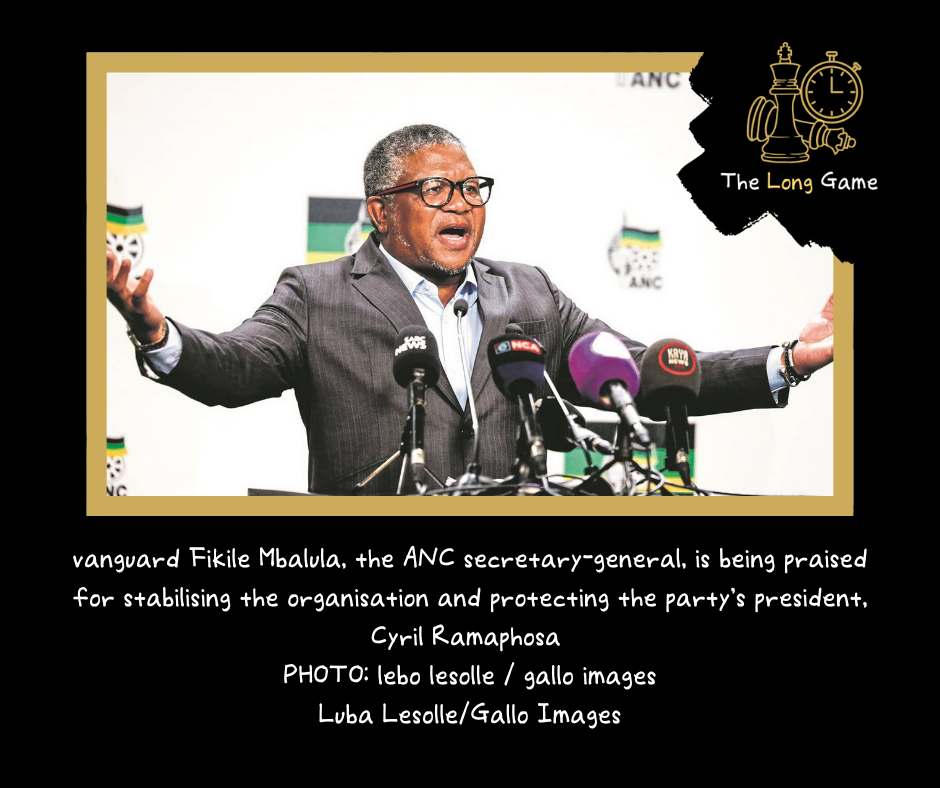
Fikile Mbalula has been the ANC secretary-general for party president Cyril Ramaphosa.

PARTY ENFORCER

Ramaphosa required not only a diligent worker and a person with determination to accomplish tasks but also a fiercely loyal secretary-general who was uncompromising in advocating the president’s expressed wishes.

In Mbalula, Ramaphosa got just that.

READ: Omry Makgoale | It is clear: The ANC is not committed to fighting corruption

What the president needed was a party enforcer to keep all the ANC structures in line, ensure that all branches, regions and provinces sang from the president’s hymnbook, and watch that no undercurrent forces operated inside the ANC, especially within the ground forces against the vision of the president.

In Mbalula, the president got that enforcer. Mbalula understood his enforcer role immediately and this was clear when he addressed his first press conference after his election in 2022.

Mbalula said:

I said in some of my political lectures that the secretary-general ngumatshingilani [is a security guard].

“I am matshingilani. That’s my work. There’s nothing about the ANC that can happen without me … If a member of the ANC is promoting anarchy and doing their fighting somewhere, I must be responsive to that.

“But I work through the structures and those structures must be effective and must do their job. Anyone who is sleeping on the job is going to have a problem with me.”

RAMAPHOSA AND MBALULA: A DREAM DUO

There was justifiable criticism of the Ramaphosa lobby group for rallying behind Mbalula as their secretary-general over and against other more capable contenders for the office.

There was also a sense that Mbalula’s limitations and blind spots were well known and he was prone to making gaffes that might overshadow the message of the organisation.

This was a fair judgement and one cannot say Mbalula has not done just that.

In fact, in his first year in office, Mbalula’s trend was to make off-hand remarks that were not thought-through, which he later corrected. But they were a source of embarrassment for the organisation, given the league of extraordinary men who had held the office before him.

READ: Mondli Makhanya | BELA Bill: Who blinked first, Ramaphosa or Steenhuisen?

The scepticism, however, had to be matched with the truth that, in all the work Mbalula had done – in politics and in government – he always brought unmatched levels of energy, enthusiasm and hard work.

This was exactly what the ANC needed after Mbalula’s predecessor, who ran the party through self-appointed interim structures and seemed incapable of taking any structure to the conferences.

While Ramaphosa had the unenviable task of rebuilding the state institutions destroyed by state capture and graft, he could count on Mbalula to do the same with the ANC, and the new secretary-general delivered like a fanatic on the mission of his life.

Back-to-back, he took every structure of the ANC to the conferences so that these structures could restore the party’s credibility and govern themselves.

What Ramaphosa was doing in government, Mbalula was replicating in the ANC; a dream duo that had not been seen in a while. Mbalula and Ramaphosa took over the ANC at such a consequential time when the organisation seemed to be coming apart at the seams. It was split by ideology, corruption, sins of incumbency and political gate-keeping, among other weaknesses.

It’s safe to say nothing has been accomplished without the grit and passionate attitude of Mbalula towards his responsibilities. What has emerged is a story of a secretary-general, sometimes loose with his tongue and prone to putting his foot in his mouth, but a man who has stabilised the ANC and rallied the organisation behind its president and his message.

The ANC Youth League went to the conference after years of nadir and the provinces, such as the Western Cape, that had been moving from one interim structure to the next also went to the conference.

The women’s and veterans’ leagues and every other ANC structure that had no legitimate elected leadership for years are now fully functional with legitimate leaders chosen by the ANC members. All this has happened under the guidance and drive of Mbalula.

SECRETARY IN THE GNU ERA

The ANC has been fortunate to have the best secretary-generals over the years, who have served their presidents and the organisation with loyalty and honour.

Sol Plaatje; Selope Thema; James Calata; Walter Sisulu; the longest serving secretary-general under the presidency of Oliver Tambo, Alfred Nzo; and the more recent secretaries Kgalema Motlanthe and Gwede Mantashe, among others, were all fiercely protective of their presidents and loyal to the organisation.

READ: VOICES | Simelane must step down or be fired

It was the first time in the organisation’s history that we saw Ace Magashule, as secretary-general, declare in his speech after being elected, a desire to see his president removed from office. While the ANC presidents and secretaries have always been united, at a provincial level, chairpersons and their secretaries have somehow always been divided.

As a result, they end up pulling in different directions, with the secretaries biding their time until the chairperson makes a mistake and they engineer a soft coup.

This may explain Magashule’s attitude coming from his position of chairperson of the ANC in the Free State and bringing that divisive attitude between him and the president after he was elected secretary-general.

He was never going to succeed because such a tendency is foreign to the ANC national leadership.

Mbalula, however, has followed the old tradition of being a political protector of his president against enemies outside and inside the organisation.

Were it not for Mbalula being the secretary-general instead of Magashule, the devastating loss of the ANC in the 29 May elections, by a whopping 17%, would have led to a secretary-general engineering a soft coup to replace the party president.

One may argue that, while the ANC lost the polls in such a dramatic way, the organisation has purified its political environment and rid itself of its divisive and factional elements for the first time in a long time.

It might rise again as one, free of Jacob Zuma, Magashule, the radical economic transformation gang and other offshoots that have wanted to hijack the ANC for their nefarious intentions.

Rule 4.16 of the ANC constitution beseeches all its members to “defend the unity and integrity of the organisation and its principles and combat any tendency towards disruption and factionalism”.

That responsibility does not only lie with the secretary-general; all the ANC members must protect the organisation and defend its decisions.

  • Diko is an ANC member and former spokesperson for the human settlements department

Original Article Link: https://www.news24.com/citypress/voices/yonela-diko-fikile-mbalula-the-bombastic-and-unfiltered-sg-ramaphosa-needed-20240922